
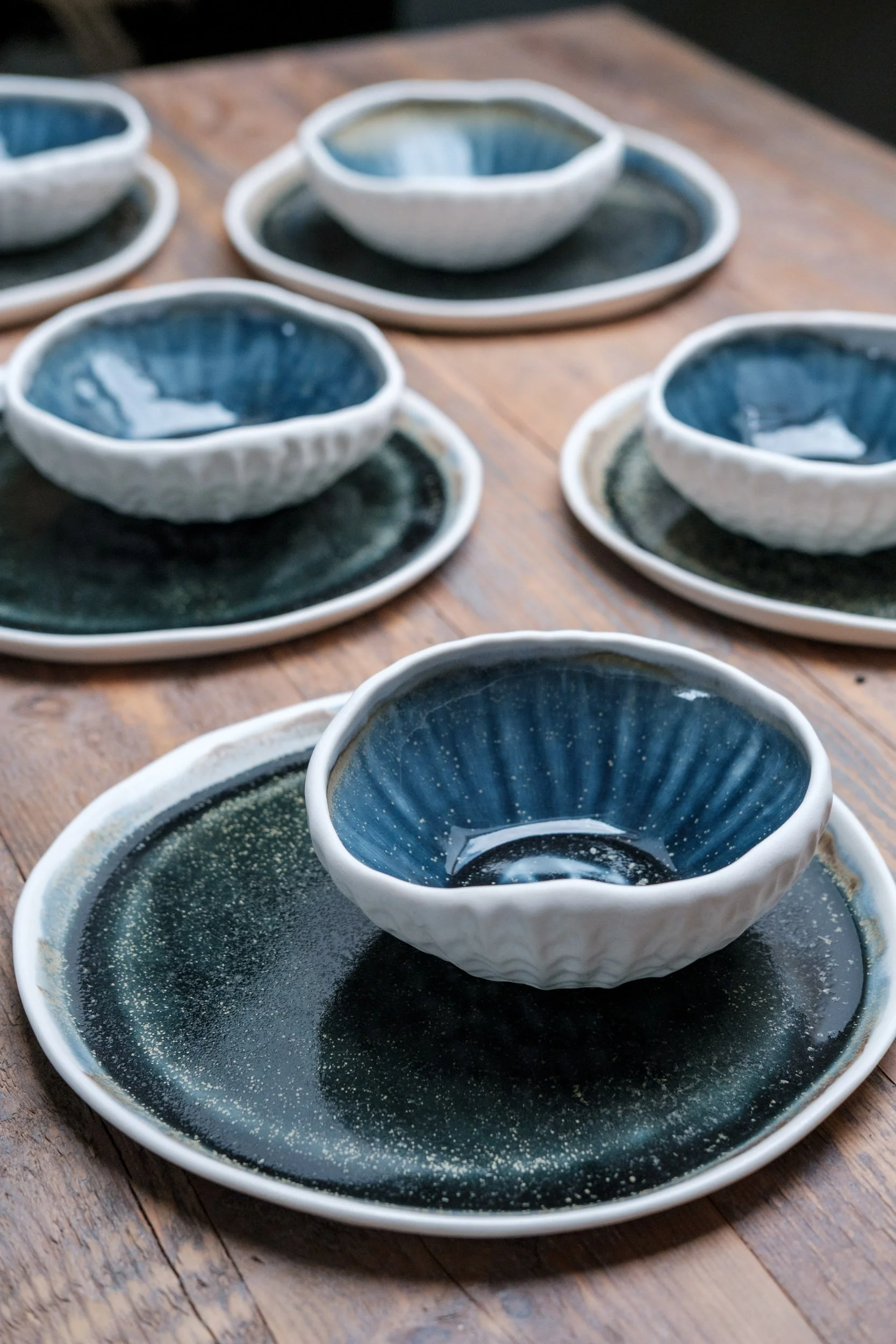
How to Choose the Perfect Dinnerware Set: A Guide to Materials, Shapes and Sizes
Learn how to choose the perfect dinnerware set with our guide to porcelain vs. stoneware, plate and bowl sizes, ceramic profiles, durability and everyday use.

THE MATCHA BOWL PROJECT
For this ongoing project, we are creating a collection of hand-thrown matcha bowls as a way to explore and document the full range of our studio glazes.
The result is both a collection of functional matcha bowls and an evolving glaze library in three dimensions.

What It Really Costs to Keep a Herd of 4 Horses in Latvia
Behind the peaceful image of horses grazing in the Latvian countryside is a real number: keeping our herd of 4 came to nearly €40,000 this year. Here's the honest, line-by-line breakdown — from feed and farrier bills to sending two horses to "university" in the Czech Republic.

July Pottery Wellness Course 2026
This July, four potters joined us for an immersive journey into ceramics in the Latvian countryside.

June course with wood-firing 2026
This June, four potters joined us for two immersive weeks of clay and creativity in the Latvian countryside.

Amtshaus restaurant in switzerland
A new hospitality project takes our ceramics to Switzerland — 60 handmade place settings for Amtshaus restaurant, featuring our Yutori collection in black and white alongside our classic elongated serving plates in the Stone glaze.

Porcelain Plates for a Restaurant in the USA
A recent wholesale project brought 160 handmade porcelain plates from our rural Latvian studio to a restaurant in the USA. Finished in our soft beige matte SAHARA glaze, the collection reflects a growing desire for quiet, timeless dinnerware designed to support food rather than overpower it.

Single Firing Ceramics (Raw Glazing) — Is It Worth It?
After years of experimenting in our studio, we’re sharing the honest reality behind skipping the bisque firing — what worked beautifully, what failed spectacularly, and when raw firing can genuinely save time, energy, and production costs.

MIERVAlDiS – HORSE FOR SALE
Our wonderful 7-year-old gelding Miervaldis (Lord of Peace) is offered for sale — to an educated owner seeking a thoughtful, versatile partner.

SPA IN CROATIA
A large spa opening in Poreč, Croatia, chose a collection of handmade pieces for their treatment rooms, rituals, and entrance spaces — all made in our rural Latvian studio.

BRONZE RIM PORCELAIN
The bronze rim isn’t just decoration — it responds to the surface beneath it. On satin matte it feathers softly outward, while on glossy glaze it breaks into fluid, fractal-like patterns.

HORSE-HAIR RAKU FIRING
Horse hair raku is a low-temperature firing technique where strands of hair are placed onto glowing hot ceramic, instantly burning and leaving delicate, one-of-a-kind markings. In our studio, the hair is gathered slowly from our four horses over time — making each piece not just a result of fire, but of relationship and care.

Marbling with PORCELAIN & STONEWARE
Marbling clay is where material becomes decoration — patterns formed not by applying, but by combining and shaping different clay bodies.

The Search for a Transparent Matte Glaze
The search for a truly transparent matte glaze is a bit like chasing the Holy Grail — beautiful in theory, but impossible in practice. In high-fire ceramics, the very thing that creates a matte surface also scatters light, meaning true transparency and matte simply cannot coexist.

Liquid Quartz™ at Laima Ceramics
A practical guide for potters & a quiet reassurance for those who live with handmade pieces

How We Stopped Guessing Our Horses’ Nutrition — and Started Using Real Data
Here’s how forage analysis completely changed our feeding program.

The Hidden Craft of Shipping Ceramics
Shipping ceramics is complex — but it’s also learnable, manageable, and deeply worth it. In this post, we share what shipping fragile work across borders actually involves, and why it became one of the most important skills in our studio.

The Business Side of Laima Ceramics
Ceramics is only part of how our studio thrives. In this post, we share a transparent breakdown of where Laima Ceramics’ income comes from — and why diversification, international work, and education matter.

Laima Ceramics — A Two-Woman Studio
Laima Ceramics is a two-woman studio built on shared responsibility, care, and clarity of authorship. Beyond making objects, we shape a working environment rooted in trust, mutual support, and respect for the rhythms of real bodies and lives.

YUTORI — On Designing, Making, and Stepping Outside the Box
Over the years, my practice has expanded beyond the wheel. YUTORI is the result of stepping fully into my role as a designer, translating an established visual language into a new scale and purpose.